
Astaxanthin: What the Research Really Shows
Astaxanthin explained: biological properties and mechanisms, human evidence on exercise, skin and metabolism, studied doses, safety and EU conditions of use.

Twelve trained cyclists took astaxanthin and a placebo for seven days each, in random order. In a 40 km time trial they were, on average, 51 seconds faster on astaxanthin. A different team gave 32 trained men as much as 20 mg a day for four weeks and found no difference in an endurance test.
Both trials were double-blind, both were small, and both tested the same red pigment. That contradiction makes astaxanthin a useful case study in how to read supplement research. What can a molecule do in the lab? Does it move a blood marker? And does it actually make a person faster, healthier or fitter?
This article follows those three levels: the biology, the human trials on exercise, skin, eyes and metabolism, and finally dosing, safety and EU rules. The research is current to 8 October 2026. The study doses mentioned here are not personal dosing advice.
What is astaxanthin?
Astaxanthin is a red, fat-soluble carotenoid, more precisely a xanthophyll, meaning a carotenoid that contains oxygen. A long chain of alternating single and double bonds and its oxygen-containing end groups set its colour and chemical behaviour. Unlike beta-carotene, it is not a vitamin A precursor in humans. “Carotenoid” names a family of compounds rather than one shared effect, so astaxanthin is not interchangeable with lutein, beta-carotene or vitamin E just because they all have antioxidant properties. EFSA, 2011, constituent characterisation
An important natural source is the microalga Haematococcus pluvialis, which makes astaxanthin mainly as esters with fatty acids. A yeast, Xanthophyllomyces dendrorhous, also produces it. How these forms differ is covered in the section on products and dosing further down.
How well is it absorbed?
Because astaxanthin is fat-soluble, absorption depends on context. In a study of 32 men, a lipid-based formulation raised measured exposure after a single 40 mg dose by roughly 1.7- to 3.7-fold compared with the reference. Another small study found greater absorption after a meal than before one. Both measure blood levels, not health benefits. Odeberg et al., 2003, Okada et al., 2009
This only shows that the meal context affects measured absorption; it supports neither dosing advice nor a health benefit. And because formulation and conditions of intake change blood levels, the same number of milligrams can mean different things in different trials.
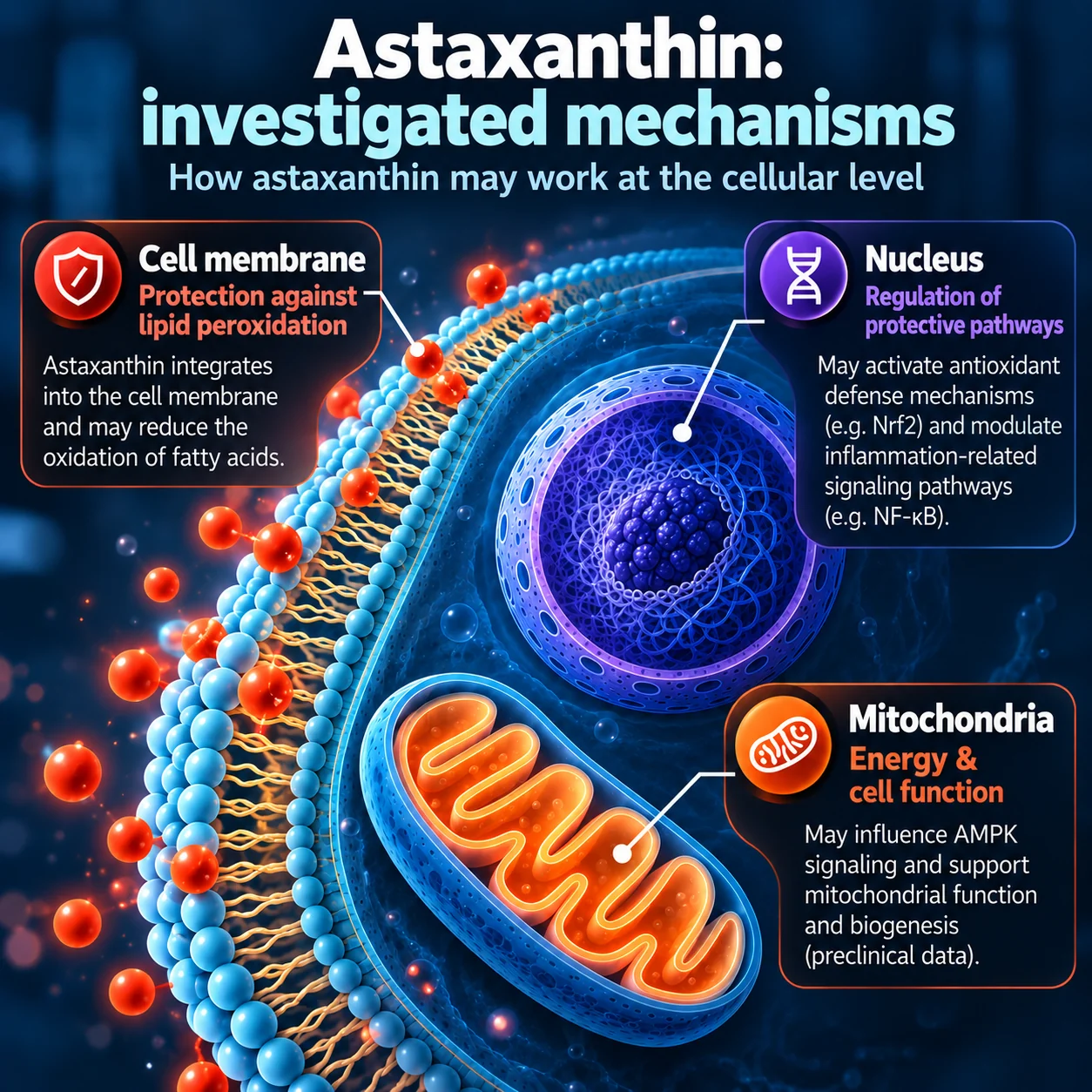
How astaxanthin might work
Cell membranes and lipid peroxidation
Cell membranes are made of fats, and fats can oxidise, much as cooking oil turns rancid in air. In a cell this happens as a chain reaction called lipid peroxidation: an aggressive molecule, typically a reactive oxygen species (ROS), attacks a lipid, and the product goes on to attack the next one. That can change the properties of the membrane.
Astaxanthin is an interesting subject for this question. Its fat-loving chain and relatively polar end groups make an interaction with lipid membranes plausible. In liposomes, which are artificial membrane models, astaxanthin slowed oxidative chain reactions involving lipids. That is a laboratory result in a model, and it should be read as one: it shows what the molecule can do chemically inside a membrane. Goto et al., 2001
The familiar drawing of a rigid rod spanning the whole membrane is too simple, by the way. A molecular dynamics simulation from 2025 describes shifting positions and changing interactions. That is structural modelling, not a picture of a human cell. Villalain, 2025
A paradox: why not simply mop up every radical?
This is where a second look pays off. Oxidative stress describes an imbalance in which oxidative processes can damage structures. But ROS are also normal signals, and during training they help the body adapt. The goal therefore cannot be to suppress every oxidative reaction. In one randomised trial, high-dose vitamins C and E affected certain cellular adaptations to endurance training, although the improvement in performance did not differ correspondingly. Paulsen et al., 2014
So with astaxanthin, the interesting question is not only whether it neutralises aggressive molecules directly, but also whether it changes biological signalling.
Signalling pathways: Nrf2 and NF-κB
Two switches are in focus. Nrf2 regulates genes of the body’s own antioxidant response, and NF-κB controls many genes involved in inflammation. In cell and mouse models, astaxanthin influenced both systems; some effects depended on Nrf2 and others did not. Lee et al., 2018
That is not the picture of a simple “radical scavenger”, but of a molecule that may shape signalling responses. Which of these responses occur in people at ordinary oral doses can only be settled by human studies.
Mitochondria and the energy sensor AMPK
Mitochondria supply the cell with energy and take part in redox signalling. In insulin-resistant mice and in muscle cells, AMPK, a cellular energy sensor, was linked to changes in mitochondrial biogenesis, the building and renewal of these cellular power plants. Nishida et al., 2020
For athletes that sparks curiosity, but a disease model is not a healthy person in training. What matters in practice comes from the human trials that follow.
What the human evidence shows overall
A single study is rarely the last word. Confidence comes from design, comparator, sample size, outcome and replication. Astaxanthin research combines small samples, different preparations, many outcomes and varied populations. Some work has industry support. That does not invalidate it, but it makes independent replication especially valuable; for the skin literature, a systematic review documents such commercial connections. Ng et al., 2021
Mechanisms
Membrane models, cell experiments and animal studies provide plausible explanations. They do not answer a clinical benefit question.
Human findings
Some performance and skin results are positive; other trials show no advantage. Metabolic findings depend on the population studied.
Unresolved outcomes
A reliable general performance benefit, disease prevention and benefits over many years have not been established.
Then there is the size of the effect. A small difference can matter in competitive sport, but with a tiny sample it still needs confirmation. Conversely, a non-significant result does not prove that every possible effect has been ruled out.
Exercise performance and recovery
Endurance: three cycling studies, three answers
The 51 seconds from the opening come from the study by Brown and colleagues. Twelve trained recreational cyclists received 12 mg daily for seven days or placebo in a double-blind crossover. In a 40 km time trial they were on average 51 seconds faster with astaxanthin; the 95% confidence interval runs from 6 to 96 seconds. That is an interesting result for exactly this group and these conditions, from a very small sample and a short period of intake. Brown et al., 2021
Set against it is the study by Res and colleagues: 32 trained men were randomised, and 20 mg daily for four weeks improved neither endurance performance nor fat oxidation in the double-blind placebo comparison, even though blood levels rose. Res et al., 2013
A third study asks a slightly different question: ten active young men lasted longer at a fixed workload after 28 mg daily for four days. The randomised crossover was single-blind, and a test to exhaustion measures a different outcome from a time trial. Tsao et al., 2025
A sport-specific trial also reports a positive signal. In a double-blind, placebo-controlled study from China published in 2025, 42 male taekwondo athletes aged 15–18 were randomised and 37 were analysed. Table 1 gives ages of 15–17 for the astaxanthin group and 15–18 for the placebo group. With 12 mg daily for four weeks, sport-specific kicking tests improved compared with placebo, while body composition did not. Age and sport limit how far this carries over to adult strength or endurance athletes. Zhang et al., 2025
The 12 mg was a research dose, not advice for adolescents. It exceeds the 8 mg daily that the EU allows for the H. pluvialis oleoresin discussed below in food supplements for people older than 14. These conditions of use govern the food and its marketing in the EU; they do not decide whether a scientific study in China was permissible. Current EU conditions of use
What does it add up to? The broader 2026 meta-analysis found no significant overall benefit for VO₂max, time-trial performance or peak power. It draws on 24 eligible study reports, though not every report contributes to every outcome, and some tested combination treatments. The individual positive signals are real; a reliable general endurance effect does not follow from them so far. Liu et al., 2026
Muscle soreness and blood markers are different questions
The results diverge here too. In a small trial of 19 resistance-trained men, the astaxanthin group reported less soreness after four weeks at 12 mg daily, without a matching advantage in strength or repetition tests. A double-blind crossover in 13 men at the same dose and duration found no benefit for soreness, muscle damage markers or anaerobic performance. Barker et al., 2023, Waldman et al., 2023
The meta-analyses show the same pattern. One 2026 synthesis found lower CK and LDH levels; another, covering seven RCTs and 188 participants, found mostly no clear effects apart from a marker of oxidised proteins. Their underlying studies overlap, so they are not independent confirmations. Liu et al., 2026, You et al., 2026
CK and LDH are enzymes measured in blood, not a direct readout of how ready you are to train. A lower lab value on its own does not establish less pain, faster return of strength or better muscle growth. If almost every session leaves you unusually drained, look first at training volume, load management and recovery. The article on 5/3/1 explains one way to build a manageable structure.
Does astaxanthin blunt training adaptation?
This question follows from the paradox above. For vitamins C and E there were signs of dampened cellular adaptation. That cannot be carried over to astaxanthin automatically, because the compound, dose, exposure, training status and outcome all differ. Positive astaxanthin findings do not settle it either: one study in older adults combined astaxanthin with tocotrienol and zinc alongside walking training. It tested a particular population and a multi-ingredient product. Liu et al., 2021
Neither “astaxanthin prevents training adaptation” nor “astaxanthin guarantees better adaptation” is justified. Comparison data are lacking for a reliable recommendation on spacing it before or after training, and shifting the timing by a few hours is not a demonstrated fix.
Skin and UV exposure
Some of the most interesting human findings sit here, mostly on cosmetic and experimental outcomes. A 2021 meta-analysis found better skin moisture and elasticity on average, with clear differences between studies. For wrinkle depth, the pooled difference was not statistically significant. Zhou et al., 2021
One experiment is especially vivid because it used controlled UV exposure. In a small double-blind placebo-controlled trial with 23 recruited participants, people took 4 mg daily for nine weeks. The threshold at which the skin reddened after irradiation, and selected moisture measures, changed more favourably than under placebo. Ito et al., 2018
Moisture, elasticity and UV-related redness are different outcomes, and small, short studies, differing measurement methods and commercial involvement limit how firm these findings are. Astaxanthin does not replace sunscreen, protective clothing or shade. An experimental redness threshold is neither a tested sun protection factor nor evidence of skin cancer prevention. Zhou et al., 2021, Ng et al., 2021
Eyes and visual fatigue
A double-blind RCT in 60 healthy regular screen users tested 9 mg daily for six weeks. An advantage in corrected visual acuity after screen use appeared in the subgroup aged 40 and above; several other functional measures did not differ. Sekikawa et al., 2023
The finding concerns that subgroup and does not support general advice to improve eyesight or treat macular degeneration or other eye disease. For persistent symptoms, vision correction, screen conditions and possible causes are the better first stop.
Cardiovascular health and metabolism
Blood lipids: markers are not events
A 2025 meta-analysis of eight studies found on average more favourable triglyceride and HDL values, but no clear effects on LDL or total cholesterol. Populations and doses varied. Laurindo et al., 2025
In a 24-week double-blind pilot trial, 34 people with prediabetes and unfavourable blood lipids were randomised. On 12 mg daily, measures including LDL changed from baseline. The primary endpoint on insulin action did not reach statistical significance, however. The study was financially supported by Fuji Chemical Industries. Ciaraldi et al., 2023
The comparison matters: a change within one group does not establish a treatment effect against placebo, and a higher HDL level does not prove that a supplement prevents heart attacks. These studies provide no evidence of fewer clinical events. The article on omega-3, EPA and DHA also discusses the gap between markers and benefit, although the compounds and their evidence need to be judged separately.
Glucose metabolism: signals in selected patient groups
A 2026 meta-analysis of nine RCTs with 403 people with prediabetes or type 2 diabetes reported on average more favourable fasting glucose and HbA1c. HOMA-IR, weight and BMI did not change clearly. That is a signal for further clinical research, not evidence of benefit in metabolically healthy athletes. Molani-Gol et al., 2026
Results varied widely between studies. For HbA1c, statistical significance disappeared in an analysis that allowed for possible unpublished results. That model does not prove publication bias, but it shows how uncertain the pooled advantage is. HbA1c reflects longer-term glucose exposure and HOMA-IR is a calculated marker of insulin resistance; both are something other than fewer diabetes complications. Astaxanthin therefore does not replace necessary treatment.
Longer research is not uniformly positive either. In the XANTHIN RCT, 61 kidney transplant recipients were randomised to 12 mg daily or placebo for one year. The primary outcomes for arterial stiffness, oxidative stress and inflammation did not differ. This particular population does not allow a simple transfer to healthy people. Coombes et al., 2016
Cognition and other claims
A 12-week double-blind RCT in 96 middle-aged people with subjective forgetfulness examined 6 or 12 mg daily. Some test scores improved within groups, but a clear advantage over placebo was not established; repeated testing can itself produce learning effects. Katagiri et al., 2012
A 2024 meta-analysis found no clear pooled benefit for cognitive accuracy or reaction time. That does not support recommending astaxanthin to prevent dementia. Liu et al., 2024
The human findings reviewed here likewise fall short of supporting popular claims about longevity, immunity or cancer prevention. Positive cell or animal models can justify new studies; they do not answer whether people fall ill less often or live longer. The earlier EFSA assessment of several astaxanthin health claims found insufficient evidence of cause and effect for the claims it examined. EFSA, 2011
Doses and duration: what has been studied?
There is no established optimal dose for a general health or training effect. The examples below describe research, not a dosing recommendation. The higher amounts in particular must not be confused with European conditions of use.
UV skin measures: Ito 2018
4 mg daily · 9 weeks
Safety RCT: Spiller 2003
6 mg daily · 8 weeks
Screen use: Sekikawa 2023
9 mg daily · 6 weeks
Cycling time trial: Brown 2021
12 mg daily · 7 days
Endurance: Res 2013
20 mg daily · 4 weeks
Time to exhaustion: Tsao 2025
28 mg daily · 4 days
Sources and populations are given in the relevant sections; the safety RCT is Spiller and Dewell, 2003. Many studies run from a few weeks to several months. Different experiments do not add up to a reliable dose-response curve: twelve milligrams in a short crossover and twenty milligrams in another population are not a direct dose comparison.
A first direct comparison comes from a 2025 study: 32 moderately trained men received placebo or 6, 12 or 24 mg daily for four weeks in a double-blind design. Some recovery findings were better at 12 mg, while 24 mg was not consistently better. With eight participants per group and many outcomes, no optimal dose can be derived. Wang et al., 2025
Natural, yeast or synthetic? The chemical forms
Not all astaxanthin is the same. Algal astaxanthin is predominantly esterified with fatty acids and mainly has the spatial configuration 3S,3′S; the yeast mainly makes 3R,3′R, and synthetic astaxanthin is a mixture of spatial forms. The ester forms were already identified in a foundational algal analysis from 1981. Isomer analysis, 2000, biosynthesis study, 2021
These differences are real chemistry. They do not establish a general clinical advantage for “natural” products, which would take direct comparisons in humans.
The European safety framework
In 2020, EFSA considered up to 8 mg astaxanthin daily from food supplements, on top of usual dietary intake, safe for adults. The ADI used in that assessment is 0.2 mg per kilogram of body weight per day for total intake. An ADI is a toxicological reference value, not an effective or individually recommended supplement dose. EFSA, 2020
For astaxanthin-rich oleoresin from H. pluvialis, the current EU Union list sets maximum daily amounts of astaxanthin in food supplements:
- Ages 3 to under 10: 2.3 mg.
- Ages 10 to under 14: 5.7 mg.
- General population over 14: 8 mg.
These are conditions of use for the named novel food in food supplements under Directive 2002/46/EC, not dosing advice and not general limits for every source of astaxanthin. Labels must warn against consumption by children under 3 and, depending on the product’s target age group, by those under 10 or under 14. They must also warn against consumption if other food supplements containing astaxanthin esters are taken on the same day. Regulation (EU) 2023/1581, Annex, Union list, version of 10 August 2026
A study using 12, 20 or 28 mg does not extend these conditions and does not, on its own, establish that those amounts are safe for everyday use. On a product, what counts is the amount of astaxanthin, not just the weight of the algal extract or the capsule. Origin, a complete ingredient list and traceable quality checks tell you more than slogans like “maximum antioxidant power”.
Safety, interactions and open long-term questions
In a double-blind safety trial in 35 healthy adults, 6 mg daily for eight weeks caused no clinically important differences in the laboratory and blood pressure values examined. That statement applies only to that setting; a small short-term trial cannot rule out rare problems or ones that emerge only after years. Spiller and Dewell, 2003
The one-year XANTHIN study extends the observation period but does not replace broad long-term safety testing in healthy people. Open questions remain mainly around years of high-dose use, several combined supplements and particular life stages. Coombes et al., 2016, EFSA, 2020
Medication: a concrete warning signal
A case report describes a 69-year-old woman taking warfarin and other medicines, including aspirin. After she started 16 mg astaxanthin daily, she developed bruising and her INR rose sharply. The situation normalised after she stopped and was treated. A single case proves neither a general interaction nor how often it occurs, but it is a relevant signal. Santiyanon and Yeephu, 2019
If you take warfarin, do not start on your own and do not change your medication. For other medicines that affect clotting, too, a doctor or pharmacist should check the combination first; the case cannot be extended across the board to all preparations. For many other possible interactions, reliable direct human studies are missing. That justifies neither a long list of supposedly proven interactions nor the claim that astaxanthin is “interaction-free”.
Pregnancy and breastfeeding: The research reviewed here provides no sufficient direct safety data for routine use; discuss voluntary supplementation with a healthcare professional first. Medical conditions and regular medication: Findings in selected patient groups are not individual clearance. Children and adolescents: Adult doses or high sport-trial doses are not a suitable standard, and age-dependent authorisation conditions do not replace paediatric advice.
Take unwanted symptoms or reactions to ingredients of the specific product seriously. The studies do not allow a dependable ranking of side effects by frequency. Unusual bleeding, marked allergic symptoms or other acute symptoms call for medical assessment.
Scientific findings and advertising claims
In Europe, the Health Claims Regulation governs health claims for foods and food supplements in commercial communication. A published study, a novel-food authorisation and an authorised health claim are three different things. Regulation (EC) 1924/2006
Discussing a possible effect scientifically therefore does not automatically permit a matching advertising line on a product page. EFSA’s safety assessment in particular is not an authorisation of claims such as “protects cells” or “improves performance”. This article evaluates research and gives no product-specific guarantee of efficacy. EFSA, 2011, EFSA, 2020
Conclusion: interesting, but no shortcut
Back to the two cycling studies from the start. They do not disagree because one of them must be wrong. They show how much depends on dose, duration, population, test and chance, and that holds for astaxanthin research as a whole. There is a plausible biological basis, and there are genuine positive human findings for individual skin measures, performance tests and metabolic markers that deserve a fair hearing. Alongside them stand null results and a meta-analysis with no endurance benefit.
For healthy people who train, that adds up to no strong general recommendation so far. Anyone who is interested anyway decides based on their specific goal, medicines, medical conditions and the European framework; with a medical condition, the decision belongs in clinical care. A small change in everyday life is also hard to pin on the supplement alone, since training, sleep and expectations often shift at the same time.
A sensible training plan, adequate nutrition and recovery remain the foundation.
Quick answers
Common questions about astaxanthin
Is astaxanthin worthwhile for athletes?
Some small trials report benefits; others do not. A reliable general improvement in endurance, strength or recovery has not been established. Training, nutrition and recovery remain the more useful first priorities.
How much astaxanthin has been studied?
Human studies use different amounts, including 4, 6, 9, 12, 20 and 28 mg daily. These are research doses, not dosing advice. For the algal oleoresin discussed here, EU conditions allow adults up to 8 mg astaxanthin daily from food supplements.
What role does fat play in absorption?
Astaxanthin is fat-soluble. In bioavailability studies, blood levels were higher after a meal and with lipid-based formulations. This describes absorption, not a health benefit or dosing advice.
Can astaxanthin replace sunscreen?
No. Small studies examine skin moisture and responses to controlled UV exposure. They do not establish protection against skin cancer or replace sunscreen, clothing and shade.
Could astaxanthin impair training adaptations?
This remains unresolved for astaxanthin. Findings on high-dose vitamins C and E cannot automatically be transferred to it. A guaranteed improvement in adaptation has not been established either.
Who should avoid starting astaxanthin without advice?
Discuss use with a doctor or pharmacist first if you take warfarin or other medicines, are pregnant or breastfeeding, or have relevant medical conditions. Adult doses are unsuitable for children; EU conditions vary by age.
Transparency
Sources and references
- Studies on Optical Isomerism of Astaxanthin in Natural Food Colors and Principal Pigment in Phaffia Color
- Metabolic engineering for high yield synthesis of astaxanthin in Xanthophyllomyces dendrorhous
- Oral bioavailability of the antioxidant astaxanthin in humans is enhanced by incorporation of lipid based formulations
- Bioavailability of astaxanthin in Haematococcus algal extract: the effects of timing of diet and smoking habits
- Efficient radical trapping at the surface and inside the phospholipid membrane is responsible for highly potent antiperoxidative activity of the carotenoid astaxanthin
- Location and dynamics of astaxanthin in the membrane
- Astaxanthin exerts anti-inflammatory and antioxidant effects in macrophages in NRF2-dependent and independent manners
- Commission Implementing Regulation (EU) 2017/2470 establishing the Union list of novel foods: consolidated version of 10 August 2026, astaxanthin-rich oleoresin entry
- Astaxanthin stimulates mitochondrial biogenesis in insulin resistant muscle via activation of AMPK pathway
- Astaxanthin supplementation does not augment fat use or improve endurance performance
- The effect of astaxanthin supplementation on performance and fat oxidation during a 40 km cycling time trial
- Effect of astaxanthin supplementation on cycling performance, muscle damage biomarkers and oxidative stress in young adults: a randomized controlled trial
- Effects of 4-week astaxanthin supplementation on athletic performance and body composition in young male taekwondo athletes: a randomized, double-blind, placebo-controlled trial
- The Effects of Astaxanthin Supplementation on Exercise Recovery Biomarkers and Exercise Performance: A Systematic Review and Meta-Analysis
- Effects of astaxanthin supplementation on exercise-induced oxidative stress: a systematic review and meta-analysis of randomized controlled trials
- Astaxanthin Supplementation Reduces Subjective Markers of Muscle Soreness following Eccentric Exercise in Resistance-Trained Men
- Astaxanthin Supplementation Does Not Affect Markers of Muscle Damage or Inflammation After an Exercise-Induced Muscle Damage Protocol in Resistance-Trained Males
- Astaxanthin supplementation enhances metabolic adaptation with aerobic training in the elderly
- Vitamin C and E supplementation hampers cellular adaptation to endurance training in humans: a double-blind, randomised, controlled trial
- Systematic Review and Meta-Analysis on the Effects of Astaxanthin on Human Skin Ageing
- The Protective Role of Astaxanthin for UV-Induced Skin Deterioration in Healthy People—A Randomized, Double-Blind, Placebo-Controlled Trial
- Effects of Astaxanthin Supplementation on Skin Health: A Systematic Review of Clinical Studies
- Effects of diet containing astaxanthin on visual function in healthy individuals: a randomized, double-blind, placebo-controlled, parallel study
- Assessing the Effects of Moderate to High Dosage of Astaxanthin Supplementation on Lipid Profile Parameters—A Systematic Review and Meta-Analysis of Randomized Controlled Studies
- Astaxanthin, a natural antioxidant, lowers cholesterol and markers of cardiovascular risk in individuals with prediabetes and dyslipidaemia
- Effects of Astaxanthin Supplementation on Glycemic Control and Lipid Profile in Patients With Prediabetes and Type 2 Diabetes: A Meta-Analysis of Randomized Controlled Trials
- Astaxanthin has no effect on arterial stiffness, oxidative stress, or inflammation in renal transplant recipients: a randomized controlled trial (the XANTHIN trial)
- Effects of astaxanthin-rich Haematococcus pluvialis extract on cognitive function: a randomised, double-blind, placebo-controlled study
- Effects of Astaxanthin Supplementation on Fatigue, Motor Function and Cognition: A Meta-Analysis of Randomized Controlled Trials
- Safety of an astaxanthin-rich Haematococcus pluvialis algal extract: a randomized clinical trial
- Interaction between warfarin and astaxanthin: A case report
- Safety of astaxanthin for its use as a novel food in food supplements
- Commission Implementing Regulation (EU) 2023/1581: conditions of use of astaxanthin-rich oleoresin from Haematococcus pluvialis algae
- Regulation (EC) No 1924/2006 on nutrition and health claims made on foods
- Scientific Opinion on the substantiation of health claims related to astaxanthin and protection of the skin from UV-induced damage (ID 1687, 1979), defence against Helicobacter pylori (ID 1686), contribution to normal spermatogenesis (ID 1688), contribution to normal muscle function (ID 1685), and “immune system” (ID 1689, 1919, 1980) pursuant to Article 13(1) of Regulation (EC) No 1924/2006
- Optical purity of (3S,3'S)-astaxanthin from Haematococcus pluvialis
- Effects of different doses of astaxanthin on indicators of muscle damage after acute exhaustive exercise: A randomized controlled study