
Progressive Overload: When to Add Weight, Reps or Sets
Progressive overload is not adding weight every session. When to add reps, weight or sets, what real progress looks like and what to check when you stall.

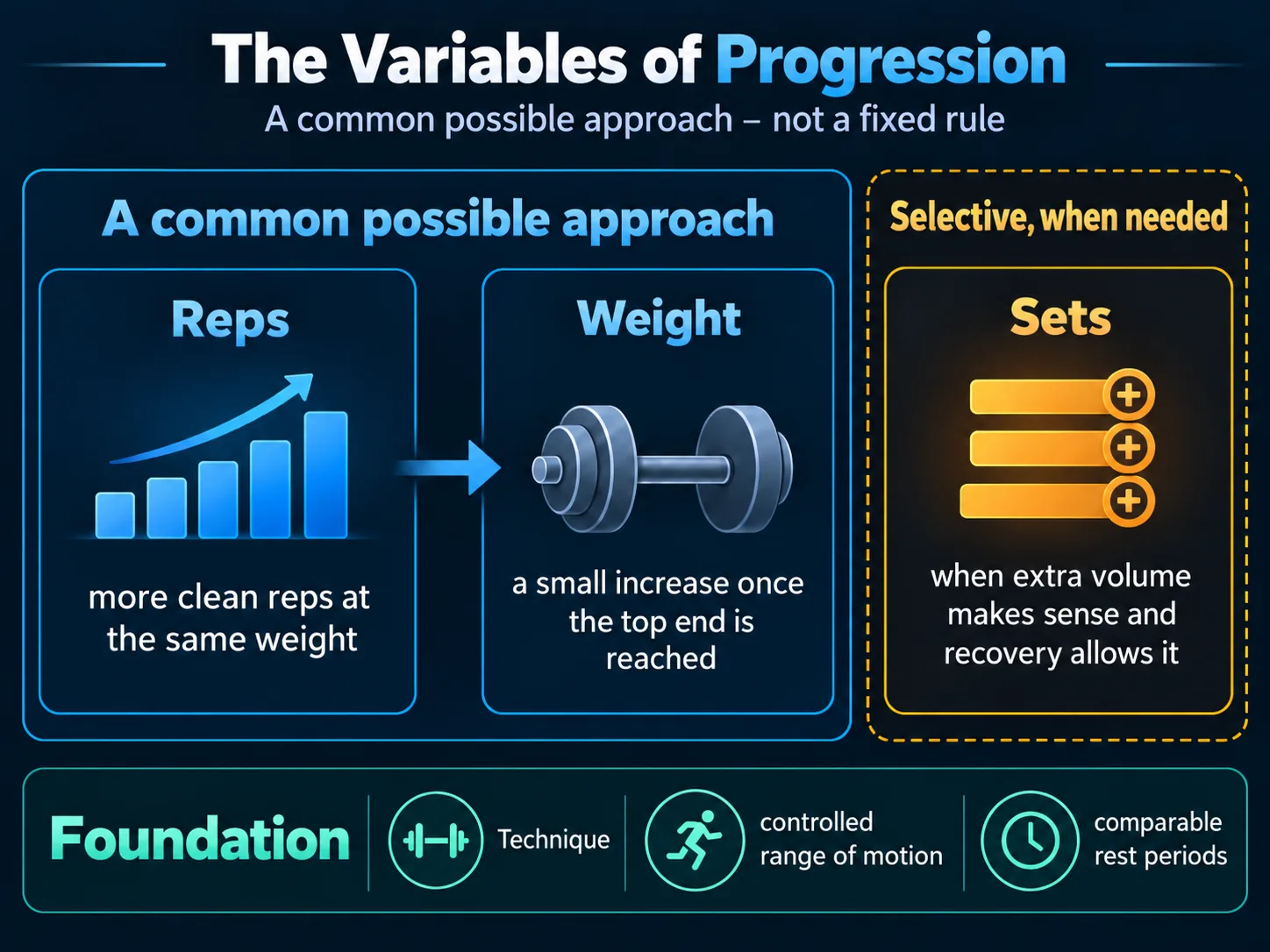
Progressive overload means your training demand keeps rising, in a planned way, as you get stronger. It does not mean putting more weight on the bar every session. A common approach is to add reps within a set range first, then weight. That is one option, not a fixed rule. Extra sets are a targeted tool for when an exercise needs more volume and your recovery can handle it.
This article covers the variables you can adjust, which one to change when, what realistic progress looks like and what to check when nothing moves.
What progressive overload actually means
Your body adapts to the demands you place on it regularly. If those demands never change, there is eventually no reason to keep adapting. That is why the American College of Sports Medicine (ACSM) position stand describes progressive programs as a requirement for further gains.
The key word is planned. Progressive overload is not “more is better” but a programming question: which variable should go up next for this exercise, and how do you know it is time? Kraemer and Ratamess describe progression in the same way, as a process of planning, tracking progress and adjusting the program.
Two common misconceptions:
- “More weight every workout.” That works for beginners for a while, but hardly at all for experienced lifters. Forcing it usually costs you technique or reps.
- “As long as it feels harder.” More fatigue is not automatically more progress. A set that feels harder only because you slept badly is not progression.
The progression variables at a glance
There are several ways to raise training demand, and not all of them fit every goal. Reps, weight and sets are easy to measure; the other variables only partly. Technique, range of motion and rest periods are also what make your weights and reps comparable in the first place.
Ways to progress
Reps
More clean reps with the same weight – within a set range, not indefinitely.
Weight
Small jumps once the reps are solid. Jumps that are too big cost reps and technique.
Sets (volume)
One more working set when needed. Can increase fatigue – so use it selectively.
Foundations and comparability
Technique and execution partly measurable
The same weight, moved with more control and cleaner reps. A foundation, not a substitute for progression.
Range of motion partly measurable
Moving from a partial to a full range is progress. Compare only at the same range.
Rest and density measurable, but misleading
The same work in less time can lower performance on later sets. Keep rest constant when comparing.
Reps
The simplest variable: you keep the weight and, over time, get more clean reps. To keep this from becoming random, you work within a fixed rep range such as 8 to 10 or 6 to 8. Once you reach the top of the range on all working sets with good form, it is time to add weight.
This route is no worse than adding load. In a 2022 study by Plotkin and colleagues with 43 trained participants, one group added weight for eight weeks while keeping reps constant, the other added reps while keeping the weight constant. Gains in muscle size and strength were very similar. The load group was slightly ahead on maximal strength, the reps group on some of the muscle thickness measurements. The authors consider both approaches viable.
Weight
Weight is the variable most people think of first. It is easy to measure and, for maximal strength, indispensable in the long run. Jump size matters: the ACSM recommends increasing the load by 2 to 10 percent once you can do the current weight for one or two reps more than your target. In practice that usually means 1 to 2.5 kg for the bench press, overhead press and isolation exercises, and up to 5 kg for squats and deadlifts.
Small exercises benefit most from small jumps. Going from 10 to 12 kg dumbbells is a 20 percent increase, often too much for a set of lateral raises. Adding reps will usually take you further there than the next dumbbell.
Sets (volume)
An extra working set adds total work and can also increase fatigue and recovery demand. The ACSM recommends multiple-set, higher-volume programs for muscle growth. That does not mean sets should climb all the time. So add a set selectively: for an exercise or muscle group that needs more volume, when you recover well between sessions and there is still room in your week. Stalled numbers alone are not reason enough; recovery or jump size is often the real issue. How many sets per muscle make sense is a topic of its own and does not fit a blanket rule.
Technique and execution
Moving the same weight with more control, a steadier tempo and no compensating movement is real progress, especially for beginners. It is just hard to put into numbers. Treat technique as a prerequisite: only once your execution is stable can you compare weights and reps at all. If you “gain” reps by letting your form slip, you have not progressed, you have changed the exercise.
Range of motion
If you could only do an exercise through a partial range so far, working towards the full range is progression, even if the weight stays the same or drops at first. The reverse is also true: more weight through a shorter range of motion is not directly comparable strength progress. Only compare performances at the same depth and the same range.
Rest and density: only with context
Shorter rest periods make training denser: the same work in less time. As a measure of progress for strength and muscle growth, that is misleading. In a 2016 study by Schoenfeld and colleagues with trained men, resting three minutes between sets led to greater gains in strength and muscle size than resting one minute. Shorter rests are not automatically progress.
In practice: keep rest periods constant on your key exercises so that weight and reps stay comparable. Density as a variable of its own fits goals like muscular endurance or saving time better.
Which variable should you change next?
The following guide applies per exercise and describes one possible approach, not a fixed rule. It assumes you have set a rep range and keep technique, range of motion and rest periods the same.
Technique still unstable or range of motion incomplete
→ keep the weight, improve execution and range
Reps are clean but below the top of the range
→ same weight, add reps
Top of the range reached cleanly on all working sets
→ add a small amount of weight, start again at the bottom of the range
Weight and reps have stalled for several sessions, recovery is good
→ check jump size and recovery first; if needed, add a working set selectively or switch progression model
Performance drops over several sessions, form suffers
→ do not progress: take a little weight off or plan a lighter week
Three progression models compared
Your progression model decides how the variables work together. Three models cover most training programs:
Linear progression
Fixed reps, weight goes up in small jumps from session to session or week to week.
Good for: beginners, compound lifts
Limits: stalls almost inevitably after a few months
Double progression
Reps within a range first, then weight.
Good for: muscle building, isolation and assistance exercises
Limits: needs a fixed range and honest counting
Training-max-based waves
Set weights as a percentage of a training max, increased after each cycle – as in 5/3/1.
Good for: intermediate and advanced lifters, main lifts
Limits: progresses more slowly, needs a realistic starting point
Linear progression is what many people equate with progressive overload. It is ideal for getting started because the body responds quickly at first. At some point your progress can no longer keep up with every session, and linear inevitably turns into something else.
Double progression is the standard for many exercises in muscle-building programs because it makes small gains visible, even when the next weight jump is still too big.
Training-max-based waves plan progression over entire cycles rather than from session to session, with set percentages for each week. How to set, progress and reset it is covered in 5/3/1 Training Max. The full system is explained in Jim Wendler’s 5/3/1 training.
Practical examples
Bench press with a rep range. You do 3 sets with 60 kg, aiming for 8 to 10 reps. Over the next sessions the number of clean reps grows. Once you hit 10 on all three sets, you move up to 62.5 kg and start again at 8.
A beginner on the squat. You start with 3 × 5 at a weight that feels clearly under control and add 2.5 kg from session to session as long as your form stays clean. That works for a while. Once you can no longer get 5 reps on every set, you progress more slowly, for example week to week, or switch to a different model.
Dumbbell lateral raises. The jump from 10 to 12 kg is too big. You stay at 10 kg, build from 12 to 15 reps and only then pick up the heavier dumbbells, again with fewer reps.
Main lift with a training max. In 5/3/1 you do not recalculate from session to session. The training max goes up after the cycle, classically by 2.5 kg for upper-body and 5 kg for lower-body lifts. If your variant uses plus sets, they show you whether that still fits – not every 5/3/1 variant does.
Why progress is not linear
Even with good training, some sessions go worse than the last one. Sleep, stress, a long workday or a missed workout all affect performance on the day. That is normal and not a step backwards. What counts is the trend over several weeks, not the single session.
Here is an example of top sets on the squat over six weeks. The estimated one-rep max (e1RM) using the Epley formula makes sets with different weights and reps comparable:
| Week | Top set | e1RM (estimated) |
|---|---|---|
| 1 | 100 kg × 5 | ≈ 116.7 kg |
| 2 | 102.5 kg × 5 | ≈ 119.6 kg |
| 3 | 105 kg × 4 | ≈ 119.0 kg |
| 4 | 105 kg × 5 | ≈ 122.5 kg |
| 5 | 107.5 kg × 3 | ≈ 118.3 kg |
| 6 | 107.5 kg × 5 | ≈ 125.4 kg |
On their own, weeks 3 and 5 look like setbacks. Over six weeks, the trend is still clearly upward. Rewriting your plan after week 5 means reacting to a bad day rather than to a pattern.
When you stall: what to check
It only makes sense to call it a plateau when neither weight nor reps have moved on an exercise for several weeks. Before you change your plan, run through a quick check in this order:
- Are you measuring the same thing? Same technique, same range of motion, same rest periods. If any of these changed, the numbers are not comparable.
- Did you actually follow the plan? Missed or rescheduled sessions often slow progress more than any detail question.
- Are your jumps too big? If you add 5 kg every time you hit your target, you lose reps faster than you build them.
- Does your rep range fit? A range that is too narrow leaves little room for progress, a very high range makes weight jumps hard to plan.
- Is your recovery keeping up? If other exercises are slipping too and every session feels heavy, more training demand is the wrong answer.
After that you have three sensible options: hold and consolidate for another round, step back by lowering the weight by a few percent and building back up with clean reps, or plan a lighter week (deload) before moving on. Only if none of that works is it time for a different model or variable, such as a selectively added set, provided your recovery keeps up, or an exercise variation.
Progressive overload in your program
Progressive overload works best when the plan sets the rule before you walk into the gym. Good programs define for each exercise:
- which rep range or percentage applies,
- which variable goes up next, and by how much,
- when to hold or step back.
Models are often combined: main lifts run on a training max in waves, assistance exercises on rep ranges. The free training plan generator follows this principle. Even in its “Flexible muscle building” approach, a training max drives the main lifts in a three-week wave plus deload.
Tracking progress with the Coach Cedric app
Without records, progressive overload is guesswork. The Coach Cedric app helps you put plan and results side by side:
- Compare plan and actual: planned working sets and volume next to what you actually did.
- Strength and volume trends: e1RM using the Epley formula, top-set volume and tonnage (weight × reps) over time.
- Carry your training max forward: after a cycle the app suggests +2.5 kg (upper body) or +5 kg (lower body) by default, or derives a suggestion from your logged top sets. You confirm every change yourself.
- Assistance exercises: you see rep ranges and your actual numbers in the app, with an optional RPE for each set. The decision to progress is yours.
The app does not detect plateaus and does not decide which variable you change. It makes your progress visible so you can make that decision based on your own numbers.
Key takeaways
- Progressive overload means raising training demand over weeks in a planned way, not adding weight every session.
- The main variables are reps, weight and sets. Technique and range of motion are what make your numbers comparable in the first place.
- A proven approach, but not a fixed rule: reps within the range first, then a small weight jump. Add sets selectively when needed, and only if your recovery keeps up.
- Shorter rest periods are not automatically progress. Keep them constant on key exercises.
- Progress comes in waves. Judge the trend over several weeks, and when you stall, check measurement, plan, jump size and recovery first.
Quick answers
Progressive overload FAQ
Do I have to add weight every workout?
No. Progressive overload means the training demand rises over weeks in a planned way. More reps with the same weight, an extra set or cleaner technique all count as progress. The weight goes up once the reps are solid.
Is it better to add weight or reps?
For muscle growth, both work. In an eight-week study with trained participants, adding load and adding reps led to very similar results. For maximal strength you will also need heavier weights in the long run.
How much weight should I add at once?
Little enough that you still hit your planned reps with good form. The ACSM suggests 2 to 10 percent once you beat your target reps by one or two. In practice that is often 1 to 2.5 kg for most lifts and up to 5 kg for squats and deadlifts.
Does shortening my rest periods count as progressive overload?
Only with caveats. Shorter rests make a workout denser, but they often lower performance on the following sets. For strength and muscle growth, longer rests are usually the better choice. Keep rest periods constant when you compare weights and reps.
What should I do if I have not progressed for weeks?
First check that you are measuring the same thing: same technique, same range of motion, same rest periods. Then look at your plan and your recovery. Often it helps to take a little weight off and build back up cleanly, or to switch to a different variable.
Transparency
Sources and references
- American College of Sports Medicine position stand. Progression models in resistance training for healthy adults
- Fundamentals of resistance training: progression and exercise prescription
- Progressive overload without progressing load? The effects of load or repetition progression on muscular adaptations
- Longer Interset Rest Periods Enhance Muscle Strength and Hypertrophy in Resistance-Trained Men