
Quercetin, Fact-Checked: Exercise, Allergies, Blood Pressure and Safety
Quercetin from onions, capers and supplements: what human trials show on performance, recovery, infections, allergies and blood pressure, and where lab findings end.

For three days in a row, 40 trained cyclists rode for three hours at around 57 percent of their maximal power. Half of them had taken 1000 mg of quercetin every day for the previous three weeks, the other half a placebo, and nobody knew who had received what. Over the following two weeks, one of the 20 cyclists in the quercetin group came down with an upper respiratory infection, compared with nine of the 20 on placebo. Three years later, the same research team tested the idea in 1002 adults over twelve weeks. Across the whole group: no difference.
Between them, these two studies tell the quercetin story in miniature. In the lab, this yellow plant compound looks remarkable: it neutralises reactive molecules, calms the immune cells that release histamine, and makes mice run for longer. The interesting question is how much of that survives once people actually swallow it, in training, during cold season, in hay fever and at the blood pressure cuff.
This article follows that question from food to the body’s handling of quercetin, then on to controlled human trials, risks and EU law. The evidence reviewed is current as of 14 October 2026. Doses mentioned from studies are not a recommendation. Nieman et al., 2007, Heinz et al., 2010
What is quercetin?
Quercetin belongs to the flavonoids, a large family of plant pigments and protective compounds, and within it to the flavonols. Purified, it is a yellow powder. In plants it rarely occurs on its own; it is usually bound to sugars. These sugar-bound forms are called glycosides, and the sugar-free form is the aglycone. Tea typically contains rutin. In onions, two glucose conjugates dominate instead: quercetin-4’-glucoside and quercetin-3,4’-diglucoside. A close relative, isoquercitrin (quercetin-3-glucoside), is the starting material for some products used in several of the studies described below. Slimestad et al., 2007
That sounds like a chemistry footnote, but it helps decide how much a person actually absorbs. More on that shortly. First, where does quercetin show up in everyday food?
Where is quercetin found?
The most comprehensive freely available overview is the flavonoid database of the US Department of Agriculture, which pools measurements from many laboratories. Some examples, each given as a mean per 100 g of edible portion:
Capers, raw
about 234 mg
Red onion, raw
about 39 mg
Kale, raw
about 23 mg
Onion, raw
about 20 mg
Cranberries, raw
about 17 mg
Apple with skin
about 4 mg
Broccoli, raw
about 3 mg
Black tea, brewed
about 2 mg

Capers top the list, but people eat them by the teaspoon. For most diets, onions, apples, berries, brassicas and tea contribute more because they turn up on the plate regularly. The order of magnitude matters: many supplements provide 500 or 1000 mg a day. The German Federal Institute for Risk Assessment (BfR) notes that such amounts exceed usual dietary intake. A result from a supplement trial therefore says little about an onion-rich diet, and vice versa. Andres et al., 2018
How the body handles quercetin
The sugar makes a difference
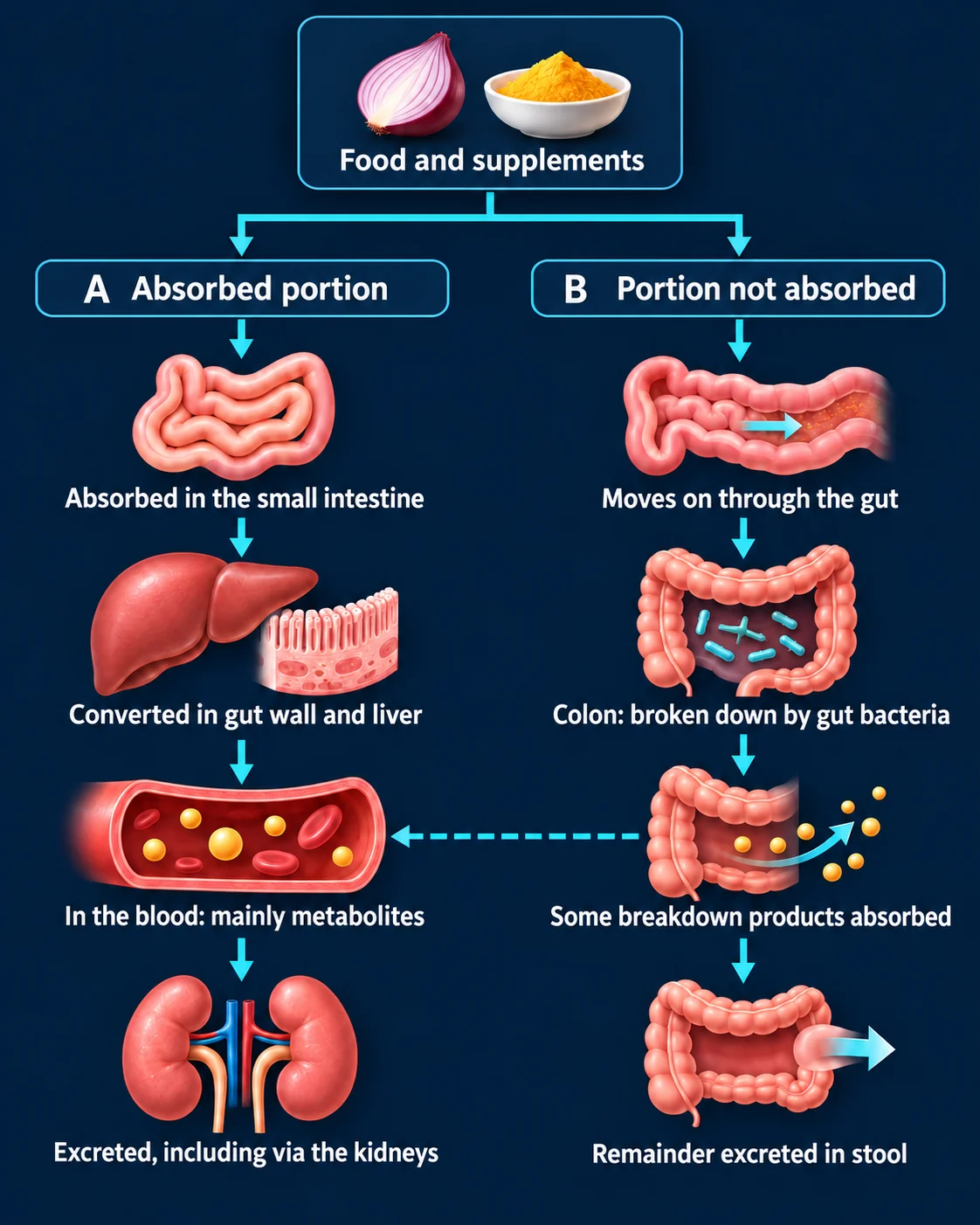
In 1995, a Dutch team measured how much quercetin the gut actually takes up, using an elegant trick. Nine people who had no colon after bowel surgery, and whose small intestine ended in an outlet, ate fried onions, pure rutin or the pure aglycone in random order. That made it possible to measure directly what left the small intestine unabsorbed. With onions, about 52 percent of the quercetin disappeared in the small intestine; with rutin, 17 percent; with the aglycone, 24 percent. Hollman et al., 1995
It matters what that figure means. It describes how much the small intestine took up, not how much quercetin reaches the blood unchanged. Only about 0.5 percent of the absorbed amount turned up in the urine. The body converts quercetin quickly after absorption; more on that below.
A follow-up study compared blood levels after onions, apples and rutin. After onions, levels rose within three quarters of an hour; after rutin, only after about nine hours. Apples and rutin reached only around 30 percent of the bioavailability seen with onions. At the same time, quercetin lingered in the blood: elimination half-lives were 23 to 28 hours, so regular intake gradually builds up blood levels. Hollman et al., 1997
Fat plays a role too. In a crossover study, nine overweight adults took the same large single dose with a fat-free, low-fat or high-fat breakfast. With the high-fat breakfast, the peak blood level was 45 percent higher than without fat. Guo et al., 2013
Very little “free” quercetin circulates
Once absorbed, quercetin is quickly modified. The gut wall and liver attach chemical groups, mainly glucuronic acid, sulfate or a methyl group. This conjugation makes foreign compounds more water-soluble and easier to excrete. After an onion meal, researchers found mainly quercetin-3-glucuronide, a methylated glucuronide and a sulfate in the blood, but none of the onion glycosides. In the lab, each of these forms has different biological properties from the pure aglycone. Day et al., 2001
And what the small intestine does not absorb? It moves on into the colon. There, bacteria break quercetin compounds down into smaller phenolic acids, some of which enter the blood and are excreted in the urine. In a study with 20 adults, about a third of the rutin consumed appeared in the urine as just one such acid; in people without a colon, only traces were found. These breakdown products are chemically different from quercetin. Olthof et al., 2003
How high blood levels get is shown by a study from Kiel, Germany: 35 healthy adults took 50, 100 or 150 mg a day for two weeks. Blood levels rose with the dose but varied widely between individuals. After 150 mg, the median peak was 431 nanomoles per litre, less than half a micromole. Blood lipids, inflammation and antioxidant markers did not change over those two weeks. Egert et al., 2008, Guo and Bruno, 2015
What happens in the lab, and why it does not automatically apply to people
The concentration gap
The 431 nanomoles from the Kiel study are the key to many misunderstandings. In cell experiments, quercetin is usually added as the pure aglycone directly onto the cells, for example at 100 micromoles per litre in the mast cell study described below. Human blood, by contrast, mainly carries converted forms, and studies measure different forms there depending on their method. The comparison therefore shows an order of magnitude, not an effective threshold: it cannot tell us how active the converted forms are or how much reaches a particular tissue.
Mast cells in culture
100 µmol/L quercetin applied directly to the cells (Weng 2012)
Blood after 1000 mg a day
about 202 ng/mL, roughly 0.7 µmol/L when converted (O'Fallon 2012)
Blood after 150 mg a day
median peak 0.43 µmol/L (Egert 2008)
That does not make lab work worthless. It shows which targets a molecule can hit and justifies targeted human studies. Whether the effect happens in the body is a question it cannot answer. Weng et al., 2012, O’Fallon et al., 2012, Egert et al., 2008

A strong antioxidant in the test tube, barely measurable in the blood
Quercetin has a reputation as a powerful antioxidant: in a test tube it can neutralise reactive oxygen species that damage fats, proteins and DNA. In people, that expectation has not held up so far. In a study of 40 athletes who took 1000 mg a day for six weeks, markers of oxidative stress and inflammation rose equally in both groups after three days of intense cycling. In a large trial with 1002 adults, twelve weeks of 500 or 1000 mg clearly raised quercetin blood levels, while measures of oxidative stress and antioxidant capacity stayed the same. McAnulty et al., 2008, Shanely et al., 2010
A strong antioxidant effect during training would not necessarily be welcome anyway. Reactive oxygen species are also signals that help muscles respond to load. In a randomised trial, high-dose vitamins C and E showed signs of blunting certain cellular adaptations to endurance training. For quercetin this question has not been tested directly; the two strength training studies further down at least show no blunted strength gains. Paulsen et al., 2014
Lab and animal studies
Many targets: mast cells, inflammatory signalling, mitochondria. Often at concentrations far above human blood levels.
Small signals in humans
Blood pressure a few mmHg lower; individual findings on recovery, strength gains in older adults, infections after heavy exercise and pollen allergy.
Not demonstrated
A noticeable performance boost in trained athletes, extra muscle growth, reliable protection against infections, benefit in histamine intolerance, prevention of cardiovascular events.
Exercise: from mice to the time trial
The exercise story starts in an animal lab. In 2009, a team from South Carolina reported that mice fed quercetin for seven days had more copies of mitochondrial DNA in their muscle and higher activity of genes that control the formation of new mitochondria. These “power stations of the cell” supply energy for endurance exercise, and the mice did run longer before exhaustion. Davis et al., 2009
The same group tested it in twelve untrained volunteers in a double-blind crossover: each person took 500 mg of quercetin twice daily for seven days once and a placebo once. Maximal oxygen uptake (VO2max), a standard measure of aerobic capacity, was 3.9 percent higher, and ride time to fatigue 13.2 percent longer. Davis et al., 2010

A second team had 26 untrained young men complete a twelve-minute run on an inclined treadmill after two weeks on 1000 mg a day. With quercetin they covered 2.9 percent more distance than before; with placebo, 1.2 percent less. Muscle biopsies showed only trends in mitochondrial markers, nothing statistically secure. Nieman et al., 2010
A third study found nothing at all. Thirty recreationally active men who were not endurance trained took 1 g a day for 7 to 16 days. Neither the muscles’ oxidative capacity measured by magnetic resonance, nor VO2max, perceived effort or performance in a ten-minute cycling test differed from placebo. The authors stated explicitly that the results from mice should not be generalised to humans. Cureton et al., 2009
What the meta-analyses make of it
Two meta-analyses pool these and other studies. The first combined eleven studies with 254 participants and found a statistically significant benefit of about 2 percent, rated as somewhere between trivial and small. The second analysed seven papers with 288 people: endurance performance improved by 0.74 percent on average, VO2max by 1.94 percent. In untrained people the performance effect was significant; in trained people it was 0.09 percent and indistinguishable from zero. The authors consider the effect likely trivial for both groups. Kressler et al., 2011, Pelletier et al., 2013
For trained athletes, that is the sober answer: a measurable jump in performance is not to be expected. The biggest lever remains training that gets progressively harder, as explained in the article on progressive overload.
Recovery and muscle soreness
Recovery after unaccustomed exercise looks a little more encouraging, but not consistently. In Rome, twelve young men took 1000 mg of quercetin or placebo for 14 days each in a double-blind crossover. They then performed ten sets of ten maximal eccentric contractions with their elbow flexors, movements in which the muscle lengthens under load. That reliably damages muscle fibres. With quercetin, strength loss was smaller and the conduction of electrical signals along the muscle fibres was better preserved. Bazzucchi et al., 2019
A Massachusetts study with 30 people, using a similar elbow-flexor protocol and the same daily amount, found no difference: strength loss of up to 47 percent, soreness, swelling and the muscle enzyme creatine kinase (CK) in the blood developed the same way with quercetin and placebo. O’Fallon et al., 2012

A 2023 meta-analysis of 13 studies with 249 participants reached a positive overall result: less soreness right after exercise, lower CK at 24 to 48 hours and less oxidative stress, while the inflammatory messenger IL-6 was unaffected. However, the authors noted some concerns about risk of bias in every included study, and almost all used 1000 mg a day. The findings come mostly from small lab protocols with unaccustomed exercise. Rojano-Ortega et al., 2023
Strength training over weeks: more strength, but not more muscle
Less soreness after a lab protocol is not the same as more strength or muscle over weeks. Two studies from Japan put exactly that to the test, both in older adults and both with quercetin glycosides.
In the shorter study, 26 healthy people aged 65 to 82 trained their thigh extensors three times a week for six weeks, holding static contractions at 60 percent of their maximal force. Under double-blind conditions, half took 200 mg of quercetin glycosides a day and the other half a placebo. Both groups got stronger, but the quercetin group gained more: maximal force rose by about 15 percent, compared with about 5 percent on placebo. Muscle mass did not change in either group. Recordings of nerve signals showed that certain motor units fired faster with quercetin, which suggests the extra strength may come from how the nervous system drives the muscle rather than from more muscle. The groups were small, only one muscle group was trained statically, and blood quercetin levels were not measured. Nishikawa et al., 2025
The longer study ran for 24 weeks. Forty-eight women and men aged 50 to 74 trained three times a week with light weights at 40 percent of their maximum and took 200 mg or 500 mg of quercetin glycosides a day, or a placebo. On the main outcome, the cross-sectional area of the thigh muscles, there was no difference: it grew by a similar 5.5 to 6.3 square centimetres in all three groups. Lean mass and maximal weight lifted also developed without group differences. The only difference was that passive stiffness of one thigh muscle fell more with quercetin. The study was funded by a company that makes health products, and four of its authors worked there. Otsuka et al., 2022
Taken together, the picture is interesting but preliminary: a strength advantage in older adults in one small six-week study, and no extra muscle growth in either study. Comparable research in young or well-trained athletes, and with classic muscle-building programmes, is missing. If you feel unusually wiped out after almost every session, the bigger levers are training volume, load management, sleep and nutrition.
Infections and immunity: the cyclist story revisited
Back to where we started. The 2007 cycling study also measured immune markers in blood and saliva, such as natural killer cell activity and salivary antibodies. These shifted with the exercise, but no differently with quercetin than with placebo. The only difference was the number of self-reported respiratory infections in the following two weeks: 1 in 20 versus 9 in 20. That is a striking finding, but it comes from a small study and is not explained by any of the immune measures taken. Nieman et al., 2007
The same year, the team tested quercetin at a 160-kilometre race, the Western States Endurance Run. Sixty-three ultramarathon runners took 1000 mg a day or placebo for three weeks before the race; 39 of them finished and provided blood samples. Inflammatory messengers, the inflammation protein CRP, stress hormones and muscle damage markers rose sharply in both groups, with no difference, even though quercetin blood levels were clearly higher. Nieman et al., 2007, Western States

The big test came in 2010: 1002 people aged 18 to 85 took 500 mg, 1000 mg or placebo for twelve weeks and logged their respiratory symptoms daily. Overall, and split by sex, body mass or age: no difference. A signal appeared only in a subgroup defined after the fact. Among 325 people aged 40 or older who rated themselves as fitter than average, those on 1000 mg had 31 percent fewer sick days and 36 percent less severe infections. Heinz et al., 2010
Subgroup findings like this point the way for new studies; they are not confirmation. Look at enough subgroups and one will show a difference by chance. Reliable protection against infections has not been demonstrated.
Inflammation markers: two meta-analyses, two answers
For the inflammation marker CRP, the syntheses disagree. A meta-analysis of seven randomised trials found an average reduction of 0.33 mg/L, mainly at 500 mg a day or more. A later meta-analysis saw no relevant overall effect on CRP, IL-6 or TNF-α, with signals only in subgroups such as people with diagnosed diseases. Mohammadi-Sartang et al., 2017, Ou et al., 2020
A difference of a third of a milligram per litre is small. It does not show that symptoms, disease or injuries become less frequent. In healthy athletes, no benefit beyond this lab value has been demonstrated.
Mast cells, histamine and allergies
What happens in the lab
Mast cells are immune cells in the skin, mucous membranes and connective tissue. They carry antibodies of the IgE type on their surface. When an allergen such as pollen binds, they release histamine and other messengers within seconds, triggering itching, sneezing and watery eyes.
In cultured human mast cells, quercetin inhibited the release of histamine, leukotrienes and prostaglandin D2 in a concentration-dependent way. It slowed calcium influx into the cell and an enzyme called protein kinase C, two steps in the signalling chain that leads to release. Kimata et al., 2000

In 2012, a Boston group compared quercetin with cromolyn sodium, a drug used as a “mast cell stabiliser”. At 100 micromoles per litre, both inhibited histamine release; for certain inflammatory messengers, quercetin was more effective in culture. The paper also describes two small open-label pilot trials without a control group in contact dermatitis and photosensitivity. One co-author worked for the company that supplied the quercetin used. Weng et al., 2012
This is where the concentration gap returns: the lab concentration was more than a hundred times the blood levels measured after supplements, even though different chemical forms are being compared. Whether mast cells in tissue are exposed to an effective amount is unknown.
Human trials in pollen allergy
Controlled human trials come mainly from Japan and concern allergy to Japanese cedar pollen. Most tested a modified form, enzymatically modified isoquercitrin (EMIQ), a quercetin glycoside with additional sugar units.
- 20 people, eight weeks during pollen season: with EMIQ, eye symptoms and eye itching over the study period were significantly lower than with placebo. Nasal symptoms showed only trends; IgE levels and several blood messengers did not change. Kawai et al., 2009
- 24 people, starting four weeks before the pollen season: eye symptoms combined with medication use were more favourable; nasal symptoms did not differ. Hirano et al., 2009
- 66 adults, four weeks, 200 mg quercetin in a lecithin formulation: several scores on a quality-of-life questionnaire, including itchy eyes, sneezing and runny nose, improved compared with placebo. Yamada et al., 2022

That is interesting but thin evidence: small groups, one type of pollen, mostly questionnaire endpoints and different products. A 2025 review notes that only two clinical trials so far have tested quercetin on its own, and calls for larger randomised trials. Quercetin is therefore not an alternative to properly diagnosed allergy treatment. Naso et al., 2025
Histamine intolerance and mast cell activation: no trials
Online, quercetin is often recommended for histamine intolerance or mast cell activation syndrome. Our PubMed search found no controlled human trial on either, only a single case report. The recommendation therefore rests on cell experiments and plausibility. Anyone with such symptoms should have the diagnosis and treatment clarified by a doctor and should not replace medication with a supplement on their own.
Blood pressure and metabolism
Blood pressure is where quercetin has left its most consistent mark in humans so far. In a double-blind crossover study from Utah, 41 adults took 730 mg a day for 28 days. In people with stage 1 hypertension, blood pressure fell by an average of 7 mmHg systolic and 5 mmHg diastolic; in people with only mildly raised values, nothing changed. Markers of oxidative stress were unaffected, unlike in animal studies. Edwards et al., 2007

In Kiel, 93 overweight adults with features of the metabolic syndrome took 150 mg a day for six weeks. Systolic blood pressure fell by 2.6 mmHg and oxidised LDL decreased. At the same time, however, “good” HDL cholesterol also fell, while CRP and TNF-α were unchanged. Egert et al., 2009
Three meta-analyses arrive at similar magnitudes: about 3 mmHg systolic and 2.6 mmHg diastolic across seven trials with 587 people, more pronounced at 500 mg a day or more; about 3 mmHg systolic and 2.9 mmHg diastolic across 17 trials with 896 people; and 2.4 mmHg systolic across ten trials with 841 people. Blood lipids and blood glucose did not change overall in the second analysis. Serban et al., 2016, Huang et al., 2020, Popiolek-Kalisz and Fornal, 2022
How should that be read? A few mmHg are not meaningless at population level, but they are small for an individual. None of these studies measured whether heart attacks or strokes became less common. Anyone taking blood pressure medication should not replace it with quercetin or add quercetin without talking to their doctor. The difference between markers and events is also explained in the article on omega-3, EPA and DHA.
Forms and bioavailability: more in the blood, more benefit?
Because pure quercetin dissolves poorly in water, several forms exist:
- The aglycone, pure quercetin, is the most common supplement form and, according to the ileostomy data, is absorbed less well than the onion glucosides. Hollman et al., 1995
- Glycosides: in onions, quercetin-4’-glucoside and quercetin-3,4’-diglucoside dominate. Products often use isoquercitrin (quercetin-3-glucoside) or forms made from it enzymatically, such as EMIQ; such glycosides were used in the Japanese pollen and strength training studies. Slimestad et al., 2007, Hirano et al., 2009
- Lecithin formulations (“phytosome”) wrap quercetin in phospholipids. In a study with twelve volunteers they produced blood levels up to 20 times higher than unformulated quercetin. The study was carried out by employees of the manufacturer and tested single doses only. Riva et al., 2019
Higher blood levels are not proof of benefit; they only show that more gets in. Whether that leads to more effect would have to be tested in trials with real endpoints. Higher levels also move further away from the amounts for which safety data exist, a point the safety section returns to.
What amounts have been studied?
There is no established dose for a general health or training effect. The examples below describe research, not a recommendation.
Blood pressure, overweight: Egert 2009
150 mg daily · 6 weeks
Strength training, older adults: Otsuka 2022
200 or 500 mg quercetin glycosides daily · 24 weeks
Pollen allergy: Yamada 2022
200 mg daily (lecithin formulation) · 4 weeks
Infections, 1002 adults: Heinz 2010
500 or 1000 mg daily · 12 weeks
Blood pressure, hypertension: Edwards 2007
730 mg daily · 28 days
Endurance, untrained: Davis 2010
2 × 500 mg daily · 7 days
Cyclists, infections: Nieman 2007
1000 mg daily · about 5 weeks
Drug interaction study: Kim 2009
3 × 500 mg daily · 7 days
Most studies ran from a few days to twelve weeks. No dose-response curve can be derived from them because populations, products and endpoints differ too much.
Safety and interactions
In 2018, the German Federal Institute for Risk Assessment summarised the data on quercetin as a dietary supplement. Across the many human trials, side effects were rarely reported and were mild when they occurred. However, adequate safety data for 1000 mg or more over more than twelve weeks are lacking. From animal studies, the BfR highlights two critical points: quercetin might worsen harmful effects on an already damaged kidney and might promote the development of oestrogen-dependent tumours. These are animal findings, not evidence in humans, but they are exactly the kind of signal that matters for long-term high-dose use. Andres et al., 2018
Newer studies change little here. In the 24-week strength training study with up to 500 mg of quercetin glycosides a day, no side effects were attributed to the product, and the rate of adverse events did not differ from placebo. We found no robust data on 1000 mg or more over more than twelve weeks in the more recent literature either (as of October 2026). Otsuka et al., 2022
A 2007 review, written in part by staff of a food-safety consulting firm, considered quercetin safe as a food ingredient on the data available at the time. An observation from an early cancer study fits the kidney question: there, quercetin was given intravenously at very high doses, and above a certain dose level dose-limiting kidney toxicity occurred. An infusion is not comparable to a tablet, but it shows that the kidney is a sensitive point at very high levels. Harwood et al., 2007, Ferry et al., 1996
Medication: documented interactions
Quercetin affects transport proteins in the gut that pump drugs back out of intestinal cells or carry them in. A well-known example is P-glycoprotein. In a study with twelve healthy volunteers, participants took 500 mg of quercetin three times a day for seven days, 1500 mg a day in total and far more than a normal diet provides. On day seven they received a single dose of the antihistamine fexofenadine. Its total exposure in the blood was 55 percent higher, and its peak level 68 percent higher, than after placebo. Whether lower supplement doses or ordinary foods have a similar effect is not something this study shows. Kim et al., 2009
With the beta blocker talinolol, another study showed the opposite direction: on average the change was not significant, but in five of the ten volunteers total blood exposure fell by 24 to 61 percent when quercetin was taken at the same time. The authors explicitly do not rule out clinically relevant interactions. The direction, in other words, is not easy to predict. Nguyen et al., 2014
That leads to a clear rule: anyone who takes medication regularly, especially drugs with a narrow margin between effect and side effects, should check with a doctor or pharmacist before taking quercetin. This also applies to combination products.
Who should be particularly careful
Kidney disease and hormone-dependent cancers: the animal signals above concern exactly these groups; whether to take quercetin is a decision for the treating doctor. Pregnancy and breastfeeding: the research reviewed here provides no safety data. Children and adolescents: the studies were done in adults; adult amounts are not an appropriate benchmark. Long-term high doses: data for more than twelve weeks at 1000 mg or more are lacking. Andres et al., 2018
What EU law says
In the EU, health-related statements on foods and food supplements are governed by the Health Claims Regulation. In principle, only claims on an EU list of authorised claims are permitted. In 2011, EFSA assessed several proposed claims for quercetin, including protection against oxidative damage, the cardiovascular system and mental performance. Quercetin does not appear on the list of authorised health claims. Regulation (EC) 1924/2006, EFSA, 2011, Regulation (EU) 432/2012
Plant extracts are more complicated. The EU has suspended its assessment of many claims for plant substances, known as botanicals, for years. Such claims may continue to be used on a transitional basis if they meet the general requirements of the regulation and national rules, with the burden of proof on the seller. Whether a marketing statement about a quercetin-containing plant extract falls into this category is a legal question for each case, and this article does not answer it. Lenssen and de Boer, 2025
For this article, that means: it describes what studies measured and is neither advertising nor a product recommendation. A study finding such as “less eye itching in a small pollen study” is something different from a marketing promise such as “works against allergies”.
Open questions
Some of the most interesting questions remain unanswered:
- Which form actually works? The blood mainly carries modified forms. Whether these, the aglycone or breakdown products from gut bacteria are responsible for possible effects is unclear. Guo and Bruno, 2015
- Does it apply to trained athletes? Many performance studies used untrained people; in trained people the effect was essentially zero.
- Pollen, histamine, mast cells: larger, independent randomised trials with clinical endpoints are missing.
- Long-term safety: data beyond twelve weeks at high amounts are lacking, as are data on newer, better-absorbed formulations.
Ageing research is a special case. There, quercetin is studied together with dasatinib, a cancer drug, as a so-called senolytic, a treatment intended to clear aged cells that no longer divide. In an open-label pilot study with 14 people with lung fibrosis, walking distance and gait speed improved. In the subsequent randomised pilot trial with twelve people, physical and lung function did not differ noticeably between the groups, although the trial was too small to judge that. Justice et al., 2019, Nambiar et al., 2023 This research examines a combination with a prescription drug in serious disease. It cannot be transferred to quercetin taken alone as a supplement.
Bottom line: where quercetin might make a difference, and where we do not know
Back to the 40 cyclists. Their result, one infection instead of nine in the two weeks after three hard training days, comes from a randomised, double-blind study and deserves attention. The trial with 1002 adults was the necessary cross-check, but not an exact repeat: it looked at everyday life in a mixed population over twelve weeks, not at trained athletes straight after extreme exertion. That it found no overall difference argues against general protection from infections. Whether things are different under heavy exertion remains an open and well-founded question.
What stands out is how many places quercetin leaves a trace in humans: blood pressure that falls by a few mmHg across several meta-analyses; a meta-analysis in which soreness and muscle damage markers after unaccustomed exercise came out lower; larger strength gains in older adults in a small training study; fewer eye symptoms in Japanese pollen trials. On top of that comes a biologically plausible basis, such as the effect on mast cells in the lab.
The limits are just as clear. Many of these studies are small, short or co-funded by manufacturers, and almost every positive result sits next to a null finding. No performance advantage has been shown for trained athletes, and no extra muscle growth either. For histamine intolerance and mast cell activation syndrome, controlled trials are missing altogether. On the risk side, there are documented drug interactions and no long-term data for high doses.
Quercetin is therefore neither something everyone should take nor something to dismiss as useless. The most interesting questions are ones that targeted trials could settle: whether particular groups benefit measurably, such as older adults doing strength training, people with raised blood pressure or people with pollen allergy, and which of the converted forms actually do the work in the body. Getting quercetin from onions, apples, berries, kale and tea means getting it alongside many other useful components of a plant-rich diet. How to read supplement research in general is also shown in the article on astaxanthin.
Quick answers
Frequently asked questions about quercetin
Does quercetin improve athletic performance?
Two meta-analyses found, on average, only a trivial to small effect on endurance and VO2max, mainly in untrained people. In trained athletes, the performance benefit in one analysis was essentially zero. A small study in older adults found larger strength gains with strength training, but no extra muscle growth. Training, nutrition and recovery remain the far more effective levers.
Does quercetin help with histamine or allergies?
In the lab, quercetin inhibits histamine release from mast cells, but at concentrations far above typical blood levels. Small trials in Japanese cedar pollen allergy found benefits for some symptoms. There are no controlled human trials for histamine intolerance or mast cell activation syndrome. It does not replace allergy treatment.
How much quercetin is in food?
According to the USDA database, raw capers contain on average about 234 mg per 100 g, red onions about 39 mg, kale about 23 mg and apples with skin about 4 mg. Values vary widely. Supplements often provide considerably more than a typical diet.
What amounts have studies used?
Mostly 150 to 1000 mg a day for a few days up to twelve weeks, and 1500 mg in drug-interaction studies. These are research amounts, not a recommendation. According to the German Federal Institute for Risk Assessment, adequate safety data for 1000 mg or more over more than twelve weeks are lacking.
Can quercetin interact with medication?
Yes, this has been shown in studies with healthy volunteers: quercetin changed blood levels of individual drugs, sometimes upwards and sometimes downwards. Anyone taking medication should check with a doctor or pharmacist first.
Is quercetin recognised as health-promoting in the EU?
No. EFSA assessed proposed claims for quercetin, and quercetin does not appear on the EU list of authorised health claims. Transitional rules apply to some claims for plant extracts; whether a specific marketing statement is permitted is a legal question for each case. This article describes studies and is not advertising.
Transparency
Sources and references
- USDA Database for the Flavonoid Content of Selected Foods, Release 3.3
- Absorption of dietary quercetin glycosides and quercetin in healthy ileostomy volunteers
- Relative bioavailability of the antioxidant flavonoid quercetin from various foods in man
- Human metabolism of dietary flavonoids: identification of plasma metabolites of quercetin
- Daily quercetin supplementation dose-dependently increases plasma quercetin concentrations in healthy humans
- Dietary fat increases quercetin bioavailability in overweight adults
- Endogenous and exogenous mediators of quercetin bioavailability
- Improved Oral Absorption of Quercetin from Quercetin Phytosome, a New Delivery System Based on Food Grade Lecithin
- Effects of luteolin, quercetin and baicalein on immunoglobulin E-mediated mediator release from human cultured mast cells
- Quercetin is more effective than cromolyn in blocking human mast cell cytokine release and inhibits contact dermatitis and photosensitivity in humans
- Effect of enzymatically modified isoquercitrin, a flavonoid, on symptoms of Japanese cedar pollinosis: a randomized double-blind placebo-controlled trial
- Preventative effect of a flavonoid, enzymatically modified isoquercitrin on ocular symptoms of Japanese cedar pollinosis
- Effects of repeated oral intake of a quercetin-containing supplement on allergic reaction: a randomized, placebo-controlled, double-blind parallel-group study
- Quercetin and Its Lecithin-Based Formulation: Potential Applications for Allergic Diseases Based on a Narrative Review
- Effects of supplementation with quercetin on plasma C-reactive protein concentrations: a systematic review and meta-analysis of randomized controlled trials
- Impact of quercetin on systemic levels of inflammation: a meta-analysis of randomised controlled human trials
- Quercetin increases brain and muscle mitochondrial biogenesis and exercise tolerance
- The dietary flavonoid quercetin increases VO2max and endurance capacity
- Quercetin's influence on exercise performance and muscle mitochondrial biogenesis
- Dietary quercetin supplementation is not ergogenic in untrained men
- Quercetin and endurance exercise capacity: a systematic review and meta-analysis
- Effects of quercetin supplementation on endurance performance and maximal oxygen consumption: a meta-analysis
- Quercetin reduces illness but not immune perturbations after intensive exercise
- Quercetin supplementation and upper respiratory tract infection: A randomized community clinical trial
- Quercetin ingestion does not alter cytokine changes in athletes competing in the Western States Endurance Run
- Chronic quercetin ingestion and exercise-induced oxidative damage and inflammation
- Quercetin supplementation does not alter antioxidant status in humans
- Vitamin C and E supplementation hampers cellular adaptation to endurance training in humans: a double-blind, randomised, controlled trial
- The Effects of Quercetin Supplementation on Eccentric Exercise-Induced Muscle Damage
- Effects of quercetin supplementation on markers of muscle damage and inflammation after eccentric exercise
- Quercetin supplementation promotes recovery after exercise-induced muscle damage: a systematic review and meta-analysis of randomized controlled trials
- Quercetin reduces blood pressure in hypertensive subjects
- Quercetin reduces systolic blood pressure and plasma oxidised low-density lipoprotein concentrations in overweight subjects with a high-cardiovascular disease risk phenotype
- Effects of Quercetin on Blood Pressure: A Systematic Review and Meta-Analysis of Randomized Controlled Trials
- Effect of quercetin supplementation on plasma lipid profiles, blood pressure, and glucose levels: a systematic review and meta-analysis
- The Effects of Quercetin Supplementation on Blood Pressure - Meta-Analysis
- Safety Aspects of the Use of Quercetin as a Dietary Supplement
- A critical review of the data related to the safety of quercetin and lack of evidence of in vivo toxicity, including lack of genotoxic/carcinogenic properties
- Short-term effect of quercetin on the pharmacokinetics of fexofenadine, a substrate of P-glycoprotein, in healthy volunteers
- Effect of single-dose and short-term administration of quercetin on the pharmacokinetics of talinolol in humans
- Phase I clinical trial of the flavonoid quercetin: pharmacokinetics and evidence for in vivo tyrosine kinase inhibition
- Senolytics in idiopathic pulmonary fibrosis: Results from a first-in-human, open-label, pilot study
- Senolytics dasatinib and quercetin in idiopathic pulmonary fibrosis: results of a phase I, single-blind, single-center, randomized, placebo-controlled pilot trial on feasibility and tolerability
- Scientific Opinion on the substantiation of health claims related to quercetin (ID 1647, 1844, 1845, 1846) pursuant to Article 13(1) of Regulation (EC) No 1924/2006
- Regulation (EC) No 1924/2006 on nutrition and health claims made on foods
- Commission Regulation (EU) No 432/2012 establishing a list of permitted health claims made on foods
- Onions: a source of unique dietary flavonoids
- Chlorogenic acid, quercetin-3-rutinoside and black tea phenols are extensively metabolized in humans
- Quercetin ingestion alters motor unit behavior and enhances improvement in muscle strength following resistance training in older adults: a randomized, double-blind, controlled trial
- Effects of Quercetin Glycoside Supplementation Combined With Low-Intensity Resistance Training on Muscle Quantity and Stiffness: A Randomized, Controlled Trial
- Bridging regulation and practice: CJEU and Dutch case law on botanical health claims